
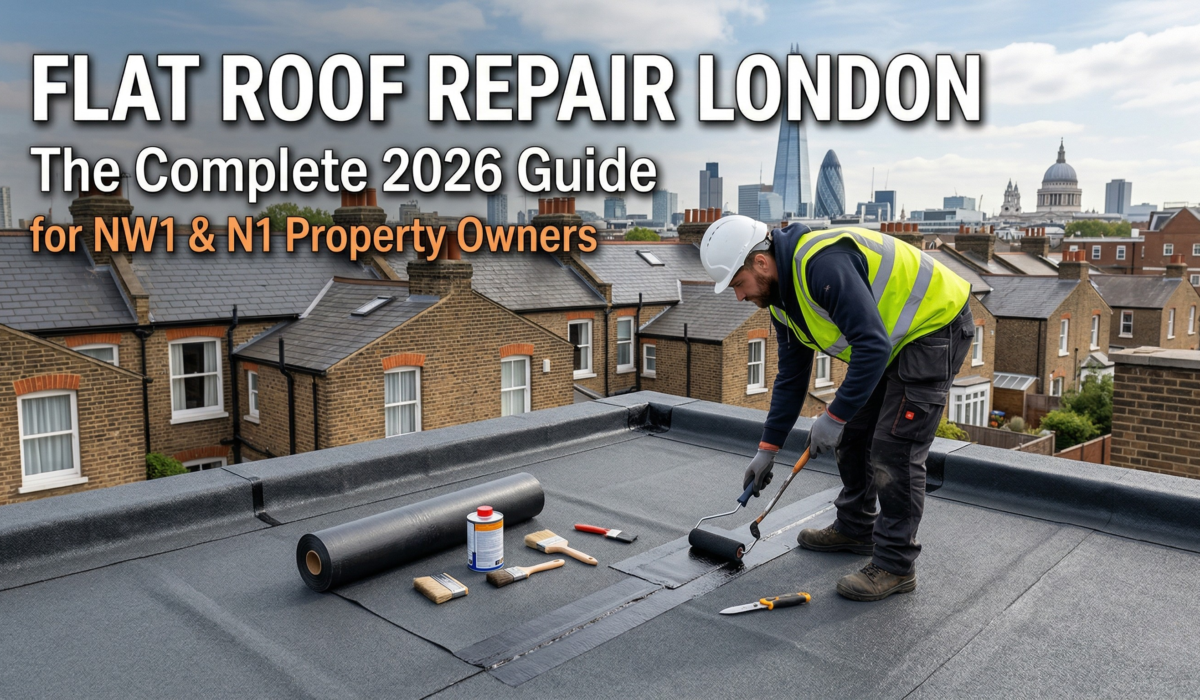
Flat Roof Repair London: The Complete 2026 Guide for NW1 & N1 Property Owners
Meta Description: Expert flat roof repair across Camden, Islington & North London. 15+ years fixing leaks, ponding & EPDM failures. Emergency callouts. Free inspection quotes.
Key Takeaways
• Flat roofs in London fail primarily due to ponding water and membrane degradation—both accelerated by the capital’s freeze-thaw cycles and heavy rainfall patterns.
• EPDM and GRP fibreglass systems dominate modern London flat roof repairs, offering 20-30 year lifespans when properly installed, far outperforming traditional felt.
• Emergency flat roof repairs in Camden (NW1) and Islington (N1) cost £350-£850 on average, depending on access, extent of water ingress, and whether structural timber has degraded.
• Most flat roof failures are preventable—annual inspections catching blocked gullies, split flashings, and membrane blistering before they become £3,000+ insurance claims.
Why Your Flat Roof Is Leaking (And Why It Won’t Stop on Its Own)
You’ve spotted the telltale brown stain spreading across your ceiling. Perhaps it’s above your kitchen extension, or that rear flat roof addition that gave you extra space ten years ago. You’ve placed a bucket, checked the forecast, and hoped it’s a one-off.
It isn’t.
Flat roofs don’t heal themselves. That small leak you’re monitoring? It’s already compromising the timber joists beneath, saturating insulation, and creating the perfect environment for rot and mould. In London’s relentless cycle of autumn downpours and winter frosts, what starts as a minor membrane split becomes structural damage within a single season.
After fifteen years repairing flat roofs across North London—from Victorian terrace extensions in Islington to modern new-builds near the Olympic Park—I’ve seen the same pattern: delayed action turns a £400 repair into a £4,500 replacement.
The London Factor: Why Flat Roofs Fail Faster Here
Weather Patterns That Punish Poor Installation
London doesn’t suffer extreme weather, but its consistency is the problem. Annual rainfall averages 600mm, with October through January delivering prolonged wet spells that test every vulnerable seam and poorly bonded joint.
The freeze-thaw cycle is particularly brutal. Water enters minor cracks, freezes overnight (expanding by 9%), then thaws. Repeat this 40-50 times per winter, and you’ve mechanically widened that crack into a structural failure point.
Flat roofs in Camden (NW1) and Islington (N1) face an additional challenge: many sit on Victorian or Georgian rear extensions where the original builders used substandard timber joists or inadequate falls. Modern membranes laid over these historic structures inherit decades-old drainage problems.
Architectural Realities Across London Postcodes
Victorian terraces (dominant in N1, NW1, NW3, NW6): Rear extensions typically feature 1:80 falls or worse—barely adequate for water runoff. Original tar-and-gravel systems have often been patched multiple times, creating a lasagne of incompatible materials.
Georgian properties (W8, SW3, parts of N1): Butterfly roofs and hidden valleys where two flat sections meet create natural debris collection points. Lead-lined gutters may be original (170+ years old) and splitting.
Modern builds and conversions (E15, W6): Ironically, these sometimes fail faster. Budget developers use minimum-spec EPDM without proper detailing around upstands, or specify inadequate insulation causing condensation issues that mimic leaks.
UK Building Regulations: The Compliance Minefield
Building Regulations Part L (Conservation of Fuel and Power) now mandates U-values of 0.18 W/m²K or better for replacement flat roofs. This means 100-150mm of insulation is standard—adding significant weight and requiring structural calculations for older properties.
Working in conservation areas (large parts of Camden, Islington, Kensington & Chelsea) means planners scrutinise even like-for-like replacements. We’ve had projects in NW1 where changing from felt to EPDM required Listed Building consent because the property backed onto a conservation zone.
Diagnosing Flat Roof Failures: What We Look For
Ponding Water: The Silent Killer
Stand on your flat roof after rainfall. See puddles that linger for 48+ hours? That’s ponding, and it’s non-negotiable evidence of inadequate falls or structural sagging.
Why it matters: Standing water degrades all membrane types. It finds the tiniest pinhole, saturates insulation, and in winter, freezes into an expanding ice lens that accelerates failure.
The fix: If ponding is minor (<20mm deep, isolated areas), we build up the surface with tapered insulation boards creating proper drainage gradients. Extensive ponding requires structural intervention—replacing sagging joists or adding a firring overlay system.
Membrane Blistering and Splitting
Felt roofs develop blisters when moisture trapped between layers expands in summer heat. Those bubbles are filled with vapour—pop one and you’ve created a permanent weak point.
EPDM rubber splits at poorly bonded seams or where installers stretched the material too tight during installation. Temperature fluctuations cause expansion and contraction; if there’s no slack allowance, the membrane tears at fixing points.
GRP fibreglass cracks when the underlying structure flexes excessively—usually a sign of undersized joists or missing noggins between supports.
Flashing Failures: Where Vertical Meets Horizontal
The junction between your flat roof and the house wall is sealed with lead flashing (traditional) or EPDM/GRP upstands (modern). This is where 60% of flat roof leaks originate.
Common failures we see in N1 and NW1: • Lead stepped flashings that have cracked due to thermal movement • Inadequate upstand height (should be minimum 150mm above finished roof level) • Missing or degraded mortar pointing where lead is tucked into brickwork • EPDM corner details without proper reinforcement patches
Flat Roof Repair Costs: London Price Reality
| Repair Type | Materials Used | Typical Cost (NW1/N1) | Duration |
|---|---|---|---|
| Emergency leak patch | Bitumen compound, temporary felt | £350 – £550 | 2-3 hours |
| Minor EPDM repair | EPDM patch, primer, adhesive | £400 – £700 | Half day |
| Flashing replacement (3m run) | Code 4 lead or EPDM trim | £650 – £950 | 1 day |
| Full membrane overlay (20m²) | EPDM or GRP + insulation upgrade | £2,800 – £4,200 | 2-3 days |
| Complete re-deck & membrane | New 18mm OSB, 120mm insulation, EPDM | £4,500 – £7,500 | 4-6 days |
London premium factors: • Congestion charge and parking permits (add £50-80/day to quotes) • Scaffold requirements for terraced properties with no rear access • Disposal costs (commercial waste in London: £180-250/tonne) • Material logistics—storing EPDM rolls in narrow Camden streets isn’t straightforward
Insights from 15 Years on London Roofs
The Case of the “Five-Year-Old” Flat Roof That Wasn’t
Recently in Islington (N1), a client called about a persistent leak in their kitchen extension. They’d been told the EPDM roof was installed five years prior and “should last decades.”
On inspection: the membrane was indeed EPDM, but the installer had committed three fatal errors. First, they’d laid it directly over the old felt without stripping back to the deck—trapping moisture and creating an unstable substrate. Second, the upstand at the rear wall was only 80mm high, well below the 150mm minimum. Third, they’d used contact adhesive on a cold January day when temperatures were below the manufacturer’s minimum application threshold.
The “repair” required complete removal and reinstallation. Cost to the homeowner: £3,200. Cost had it been done properly initially: £2,400.
Homeowner Mistakes That Cost Thousands
Assuming all flat roofs are the same: A £1,800 quote using basic torch-on felt is not comparable to a £3,500 quote for fully adhered EPDM with warm deck insulation. One lasts 10-12 years; the other 25-30 years.
Delaying obvious repairs: Every month you wait with a known leak adds roughly £150-300 in hidden damage. Wet insulation needs replacing. Saturated timber breeds rot. Damp penetration stains ceilings and walls.
Trusting “patch and pray” merchants: We regularly strip roofs that have been patched six or seven times over fifteen years. Each patch costs £300-500. Total spent: £2,500+. A proper replacement five years ago would’ve cost £2,800 and been done.
Material Selection: EPDM vs GRP vs Traditional Felt
EPDM Rubber Membrane
Pros: Single-sheet installation (minimal seams on small roofs), excellent UV resistance, 25-30 year lifespan, flexible in all temperatures.
Cons: Requires skilled installation—poor bonding causes failures. Vulnerable to punctures from sharp objects. Seams on large roofs (>40m²) are potential weak points.
Best for: Most residential flat roofs in London. Standard choice for extensions, dormer roofs, and garage conversions.
GRP Fibreglass
Pros: Completely seamless when properly installed, exceptional durability (30+ years), excellent for complex shapes with multiple upstands, can be walked on without damage.
Cons: More expensive (typically 20-30% above EPDM). Requires dry conditions during installation. Can crack if structural movement is excessive.
Best for: High-traffic flat roofs (roof terraces, balconies), complex geometries, premium applications in Kensington & Chelsea or Belsize Park.
Modern Torch-On Felt
Pros: Economical, familiar to most contractors, suitable for emergency repairs, proven 15-20 year lifespan when properly installed.
Cons: Multiple seams create leak pathways, requires flame equipment (insurance implications), shorter lifespan than alternatives, typically needs re-coating every 5-7 years.
Best for: Budget-conscious repairs, sheds, garages, temporary structures.
Navigating London Logistics: Why Location Affects Your Quote
When dispatching emergency repair teams to N1 or navigating the narrow streets of Camden, logistics directly impact pricing and response times.
Access challenges in Victorian terraces: Many properties in NW1 and NW6 have no side access. Materials must be carried through the house or craned over from the street. A 20m² EPDM roll weighs 35kg; add insulation boards, timber, and tools, and you’re looking at multiple trips or hiring a crane (£400-600 for half-day hire).
Parking restrictions: Residential parking zones in Islington, Hammersmith, and Belsize Park mean we often pay £120-150/day in permits and congestion charges. These costs are real and appear in quotes.
Response times during peak traffic: An emergency callout from our base to central locations can take 45-90 minutes depending on traffic. We’ve built relationships with material suppliers in Ealing (W5) and Newham (E15) to reduce response times for eastern and western service areas.
Preventative Maintenance: The £150 Investment That Saves £3,000
Annual flat roof inspections should include:
• Gully and outlet clearance – Blocked drainage causes ponding within hours of heavy rain • Membrane surface inspection – Checking for blisters, splits, or UV degradation • Flashing integrity – Testing mortar joints, lead condition, and upstand bonding • Fascia and soffit condition – Water tracking behind these indicates membrane edge failures • Internal damp checks – Moisture meters detect hidden saturation before visible staining appears
Cost: £150-220 for a thorough inspection with photographic report.
Return on investment: We’ve identified and rectified minor flashing splits for £280 that would have caused £2,500+ in structural timber replacement within 18 months.
For properties in conservation areas or with heritage designations, documented maintenance records also support planning applications should major works become necessary.
Emergency Flat Roof Repairs: What to Expect
The First Call
When you contact us about a leaking flat roof, we need three pieces of information:
- Leak location – Which room, proximity to walls/edges
- Roof age and type – If known (we can identify on arrival if not)
- Urgency level – Active dripping vs historical staining
Same-Day Emergency Response (Within M25)
For active leaks causing property damage, we aim for 2-4 hour response times to NW1, N1, NW3, and NW6. Other London areas typically 4-6 hours depending on traffic and technician location.
Emergency patch procedure:
- Access roof and identify leak source
- Clear standing water and debris
- Apply temporary waterproof patch (bitumen compound or EPDM patch)
- Internally contain any water ingress
- Provide written quote for permanent repair
Emergency callout cost: £350-500 (includes first hour labour, materials for temporary patch, diagnostic report). If you proceed with permanent repair within 7 days, we credit £150 of the emergency fee.
The Links You Need
For comprehensive guidance on different flat roofing systems, see our detailed [flat roofing materials guide].
Planning a complete roof overhaul? Our [roof replacement cost calculator] breaks down pricing by area and roof type.
Understanding your rights and installer obligations is essential—check the National Federation of Roofing Contractors for accredited professionals and the TrustMark scheme for government-endorsed tradespeople.
Building Regulations compliance is non-negotiable for replacement roofs. Review current standards at UK Government Planning Portal.
Frequently Asked Questions
How long does a flat roof last in London’s climate?
Modern EPDM and GRP systems last 25-30 years with proper installation and annual maintenance. Traditional three-layer felt typically achieves 15-20 years. London’s weather reduces these by 10-15% compared to drier UK regions due to increased freeze-thaw cycles and higher annual rainfall. Coastal properties or those with southern exposure age faster due to UV degradation.
Can I repair a flat roof myself to save money?
Minor EPDM patches are possible for DIY-competent homeowners using proper primer and adhesive, but the failure rate is high—around 40% require professional rework within 12 months. Felt repairs require torch equipment and training (insurance risks). Any repair involving flashings, structural timber, or insulation upgrades requires Building Regulations compliance and professional certification. The £300 you save often costs £1,500 in subsequent remedial work.
Do I need planning permission to replace my flat roof in Camden or Islington?
Standard like-for-like replacement generally falls under Permitted Development rights. However, conservation areas (extensive in NW1, N1, W8, SW3) impose additional restrictions. Changing roof materials, adding rooflights, or increasing height by more than 150mm typically requires planning consent. Listed buildings require Listed Building Consent for any external alterations. Always consult your local authority planning department before commencing work.
What causes flat roofs to leak at the edges but nowhere else?
Edge detailing is where vertical walls meet horizontal roofing—the most stressed junction on any flat roof. Thermal expansion causes materials to move at different rates (brick vs membrane), creating gaps. Inadequate drip edges allow water to track backward under the membrane. Missing or degraded pointing lets moisture penetrate behind flashings. This accounts for 60% of flat roof leaks we diagnose across London.
How do I know if my flat roof needs repair or complete replacement?
If leaks are localised, membrane surface shows minimal degradation (<20% of area), and the underlying deck is sound, repair is appropriate. Replace when: multiple leak points exist, membrane is extensively blistered or cracked, ponding is widespread, deck timber is soft/rotten, or the roof is beyond 75% of its expected lifespan. We provide moisture meter readings and photographic evidence to support recommendations—no guesswork.
Getting Your Flat Roof Fixed Properly
Flat roofs are the workhorses of London property—providing usable space, natural light through rooflights, and cost-effective extensions. When they fail, the damage escalates rapidly.
Whether you’re dealing with an active leak in your Islington Georgian conversion, ponding issues on your Camden terrace extension, or planning a complete EPDM replacement for your Hammersmith flat roof, the same principles apply: address problems early, use quality materials installed by qualified professionals, and maintain annually.
We’ve been repairing and replacing flat roofs across NW1, N1, NW3, NW6, W5, W6, W8, SW3, and E15 for over fifteen years. Every project starts with a free inspection and honest assessment—if a £400 repair solves your problem, we won’t sell you a £3,000 replacement.
Contact our team for a no-obligation roof inspection. We’ll provide a detailed condition report with photographs, a transparent quote breaking down materials and labour, and realistic timescales that account for London logistics.
Your flat roof shouldn’t be a source of stress. Let’s fix it properly.